GovCon Notes
Keith Atkinson · September 27, 2026 · 9 min read
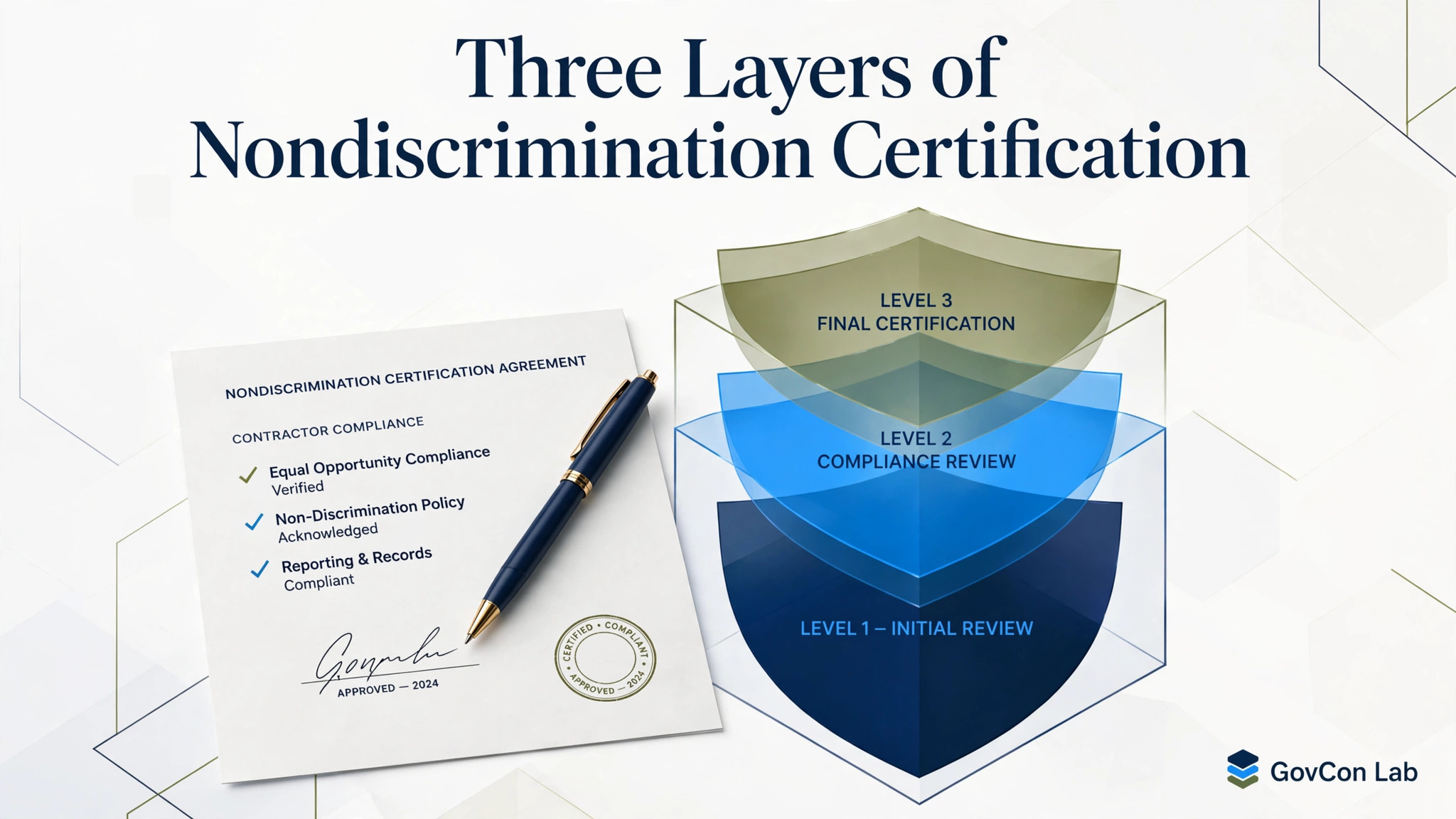
Executive Orders 14173 and 14398 changed the paperwork, the contract language, and the risk. Here is what small businesses need to understand before they sign.
A contractor may make related promises in more than one place: through company-level representations, through an Executive Order 14173 certification in an award, and through the newer FAR 52.222-90 clause. These promises overlap, but they are not identical. Read each one before signing.
For decades, many federal contractors associated equal-employment compliance with Executive Order 11246 and written affirmative action plans. Executive Order 14173, signed January 21, 2025, revoked EO 11246 and ended that executive-order framework for race- and sex-based affirmative action.
That did not make discrimination legal. Federal laws such as Title VII still apply when their normal coverage rules are met. Separate requirements for protected veterans and people with disabilities may also continue to apply. The important change is that the government now puts more weight on what a contractor certifies and what the contract itself requires.
The practical lesson is simple: one review is not enough. A statement made during registration may be different from a certification attached to a solicitation. A signed contract may then add another clause with continuing duties during performance.
Federal vendors already use the System for Award Management (SAM.gov) to maintain registration information and annual representations and certifications. A solicitation may rely on those answers, ask for updated answers, or include its own certification.
For nondiscrimination compliance, treat any statement presented in SAM.gov or an offer package as a company-level promise. Do not let one employee click through it as a routine renewal without checking whether the company's real policies and practices support the answer.
> Do not assume: A new governmentwide SAM.gov nondiscrimination statement applies to every procurement in exactly the same way. Some SAM-related certification proposals have focused on federal financial assistance, while contract agencies may use award-specific language. The controlling text is the language actually presented to you.
Executive Order 14173 tells agencies to include two important terms in every federal contract or grant award:
In plain English, this is more than a promise to follow the law. The order connects the promise to whether the government pays. If a company knowingly makes a false certification, that can create False Claims Act risk in addition to ordinary employment-law or contract risk.
The government is saying that compliance matters to its decision to pay the contractor. That does not mean every mistake automatically becomes fraud. False Claims Act cases still depend on facts and legal requirements, including knowledge and materiality. But it does mean that careless certifications can become much more expensive than a simple paperwork error.
> The safe habit is to verify the facts before anyone signs, submits, renews, or accepts a modification.
The question is not whether your company uses the word "DEI." The question is whether any actual policy or program violates federal anti-discrimination law. A renamed program can still be unlawful. A program with a DEI label is not automatically unlawful. The real issue is how people are treated and how decisions are made.
Executive Order 14398, signed March 26, 2026, directed agencies to use a standard contract clause. The Federal Acquisition Regulatory Council then published the model deviation now identified as FAR 52.222-90, Addressing DEI Discrimination by Federal Contractors.
FAR 52.222-90 defines "racially discriminatory DEI activities" as different treatment based on race or ethnicity in any of these areas:
The clause applies "in connection with the performance of work under this contract." That wording matters. Contractors should map the people, vendors, programs, and resources connected to each covered contract instead of relying only on a general employee handbook review.
The clause says its substance must be included in subcontracts at any tier, including subcontracts for commercial products and commercial services, except where delivery or performance is outside the United States. A prime contractor therefore needs more than a clause in its own files. It needs a repeatable way to identify covered subcontracts, insert the flowdown, collect acknowledgments, and handle warning signs.
A useful compliance review looks at how opportunities and resources are actually awarded. The same questions should be asked about employees, job applicants, interns, vendors, subcontractors, and participants in company-sponsored programs.
> Avoid the cosmetic fix: Do not simply rename a program, delete a few words, or move a rule into an unwritten practice. Review the eligibility criteria, selection process, funding, communications, and real outcomes. Also preserve relevant records; do not destroy documents in response to a compliance concern.
The orders and clause focus on unlawful discrimination and, under FAR 52.222-90, specified race- or ethnicity-based disparate treatment. Employers can still recruit widely, remove unnecessary barriers, enforce anti-harassment rules, provide generally available training, and use job-related selection criteria. The line can be fact-specific, so unclear programs should be reviewed before certification.
The new framework raises the stakes because the same basic subject can appear at the company, award, and contract-performance levels. A contractor should not assume that a SAM.gov renewal, an offer certification, and FAR 52.222-90 all ask the same question.
Before signing, compare the exact language with the company's current practices. Make sure the review covers subcontractors and lower-tier suppliers when the clause requires it. Keep the evidence supporting the answer. If the facts are unclear, pause and get qualified legal advice rather than guessing.
Legal note: This article provides general information, not legal advice. Executive orders, agency deviations, litigation, and rulemaking can change. Contractors should review the current solicitation, contract, modifications, agency guidance, and applicable law, and should consult qualified counsel about their own facts.